
Upgrading the Halo 3 Engineer Puppet Eyes
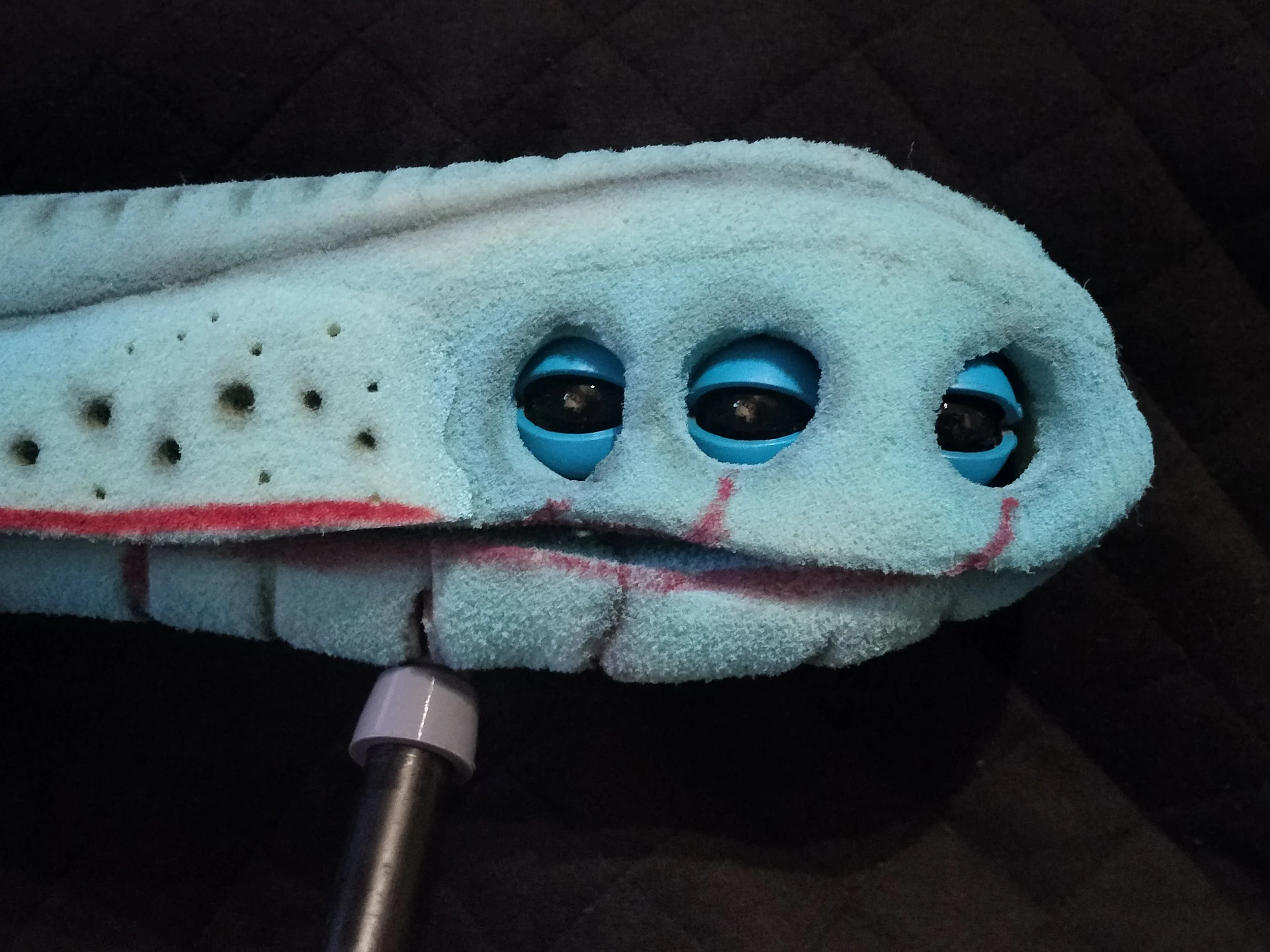

The newest eye mechanism, inside the head
One of the most important features of the Halo 3 ODST Engineer puppet, at least to me, was the eyes. As a creature creator, I keep seeing the importance that the eyes of a creature, or any character, has on defining them. So even though the Engineer’s eyes are pure black, being able to give them life, and expression, through blinking mechanisms would go a long, long way to giving it real character.

Old eye mechanism in action
The original eye mechanisms were a rushed process, and considering the limited time and knowledge I had, I am quite proud with how they came out. But they seriously needed to change. They’re loud, unreliable, and hard to make them all blink properly.
They work by six individual lines of fishing wire pulling up on the top eyelid, on one side of the pivot point. This then pulls the eye down. Two gears sit inside the eyeball, causing the bottom ones to mirror the movement. Each line is tuned on the trigger handle, and the eyes are pulled back open with springs. As rad as I think this system works, the springs get caught on stuff and play like washboards, the gears don’t mesh properly and sometimes don’t have the right force to close the bottom eyelids, and tuning all six strings so each eye closes at the same moment is a time sink.
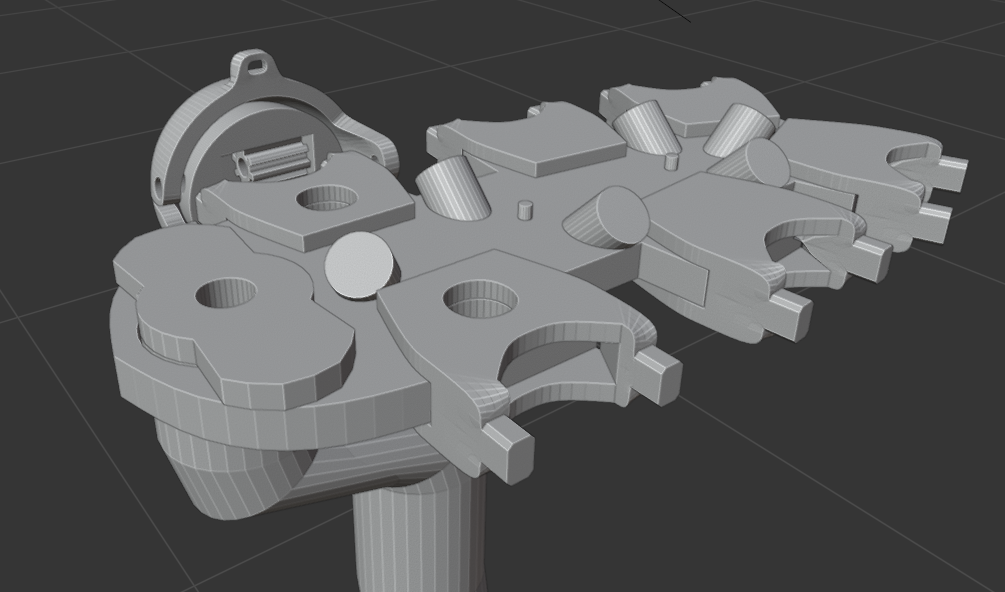
The old eye mechanism in Blender. Notice the gear behind the eyeball in the top left
The new mechanism needs to be reliable, quieter, and easier to use.
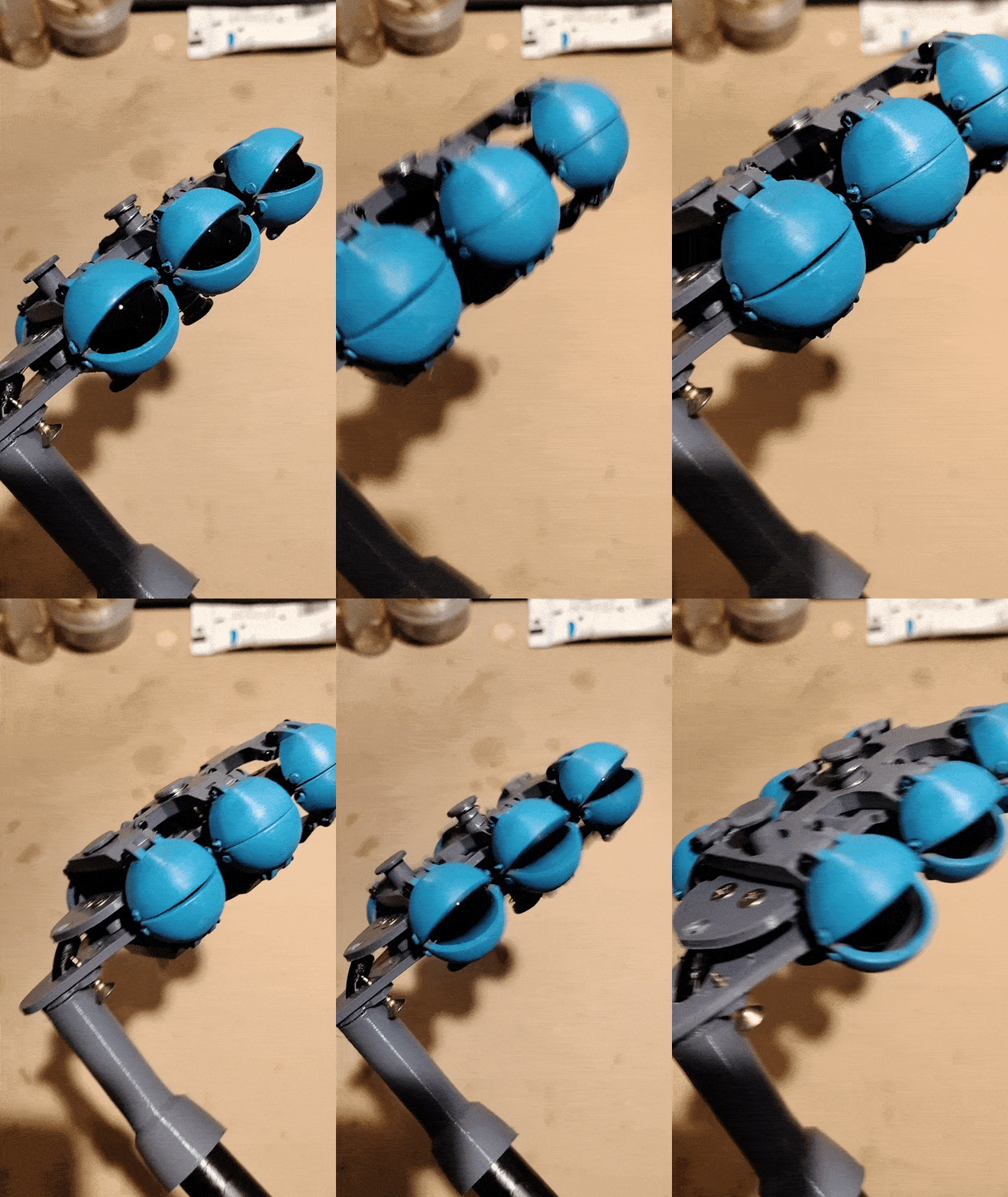
A barenaked view of the new eye mechanism
These eyeballs are the result of over a month’s work of trials and failure. The designs of every single piece changed many times to make one cohesive, reliable puppet mechanism. A number of different methods for making the eyes move were tested, but in the end, having two plates raising in either direction proved to be the best course of action, in that it was the simplest, most reliable and had the least amount of parts, compared to other prototypes. Before this path was committed to, it started out as a very basic print to prove that the method was viable.

The basic “proof of concept“ of the moving plate mech
Below was the second major iteration of the prototype. While much simpler in its designed, it could not be mirrored easily to make the other side of eyes open the same way. The general principle was kept, but how it made the plates move was changed.

Second iteration of the moving plate design
(Not shown here is also the other tested variations of eye mechs, such as one that works like a scissor lift)
The general gist of the new mechanism works by a central axle being pulled forward, which forces eight arms attached up and down, pushing plates in both directions. These plates then push on the top of the eyelids, forcing them down. A spring on either side pushes the plates back down into the resting eye-open position. These eight arms that move up and down are restricted from sitting completely vertically (unlike what is shown below), otherwise they could get locked in place.
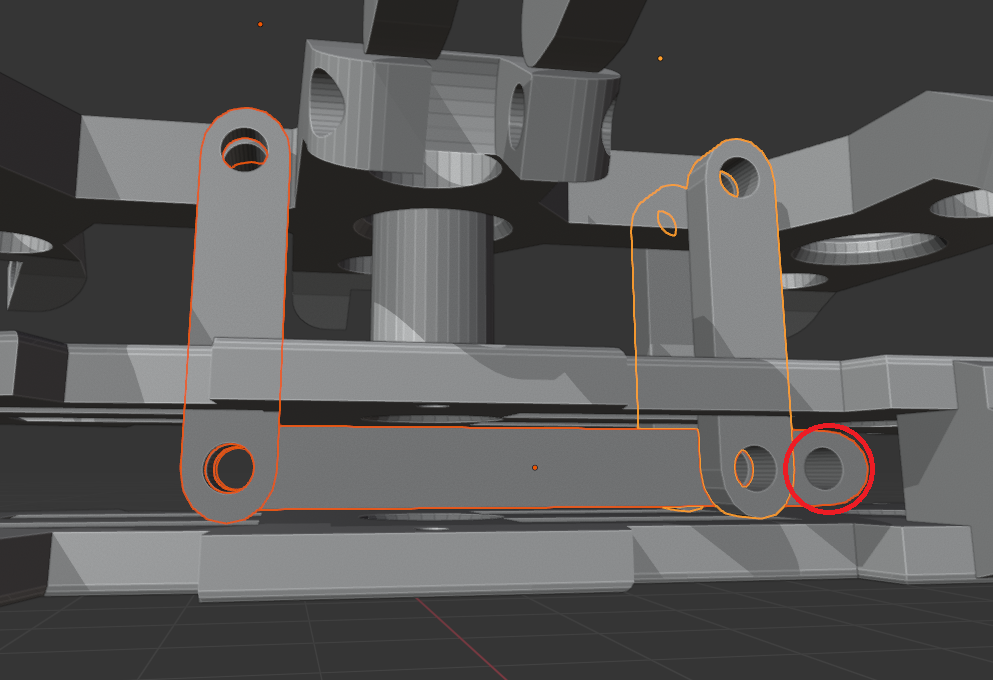
Mechanics as designed in Blender. Note the red circle, which is where the nylon line attaches and pulls the bar forward. What is show here is the “eye closed“ position. These arms and plates are mirrored on the other side.

Testing of the latest version. With a careful eye, you may notice the bar in the middle moving back and forth.
Although the system is now slightly more complex than the original, it is much more reliable, reasonably quieter and much easier to use.
The two major drawbacks to this system over the original are
1. These new mechanics require more vertical room, so some of the foam inside the head needed to be trimmed
2. There are more moving parts, so if something did happen to break, it’s a little harder to fix. These parts were printed in PLA+, but ideally, at the very least PETG should be used.
However, the eyes were designed to be as modular as possible for testing, painting and deconstruction. This has become an important factor in all of my work since the Halo CE Grunt Puppet, because even though it takes more time initially, it’ll save you a lot more time in the future. The only things that aren’t entirely modular are the plastic filament based axels. These are closed on each end by melting the tips with a soldering iron. They’re still fairly easy to replace (which became important when needing to redevelop some eyelids), they just however require access to a soldering iron or wood burner (and PPE and ventilation!)
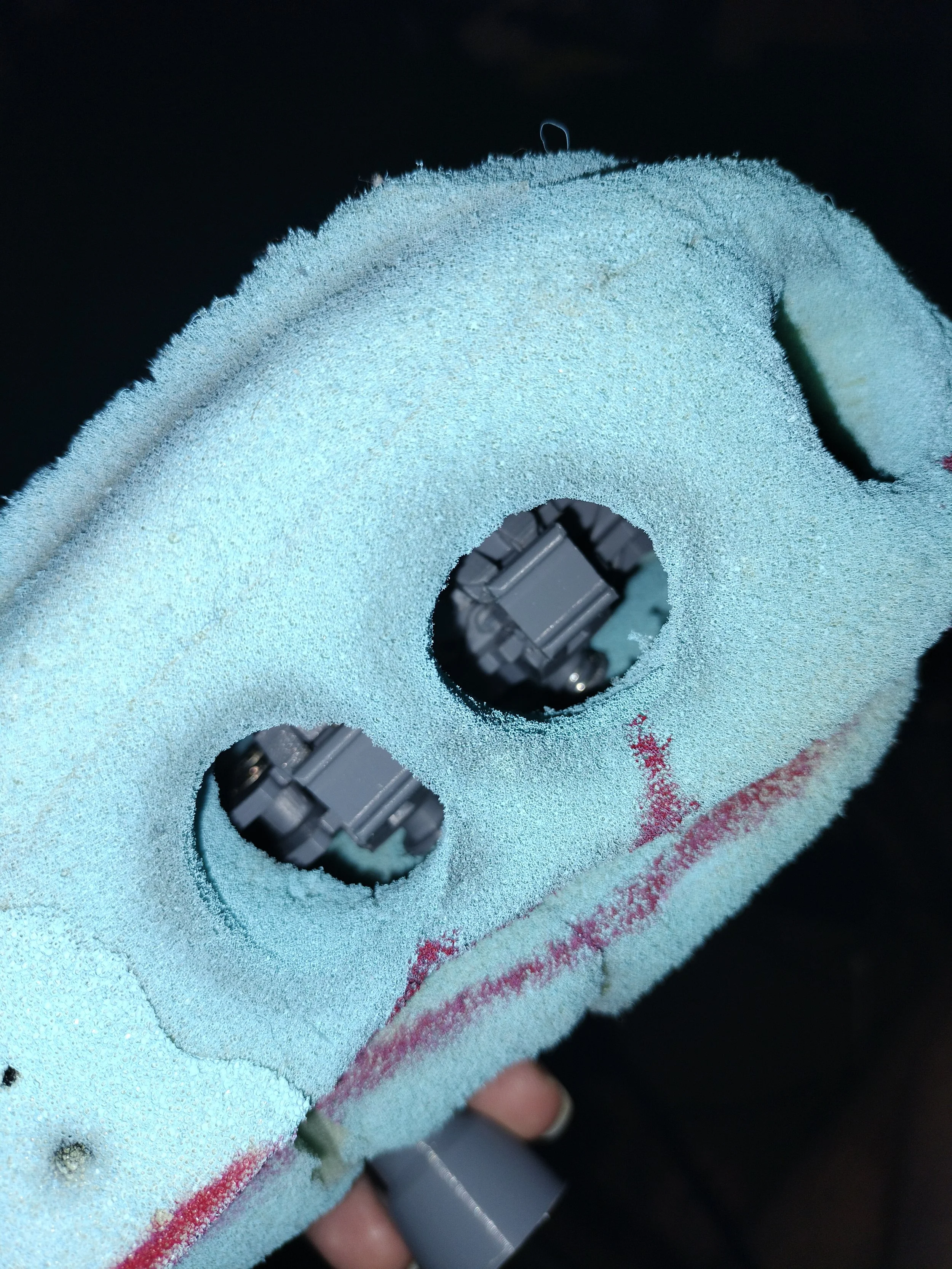

Views of the mechanism inside the head, without the eyeballs or lids
The trigger is largely the same as the original, the only difference being the trigger itself, where the two ends of one nylon rope run through plastic tubing, then through the handle of the trigger, where it is clamped down by a bolt (which will be replaced with a shorter one in the future). Oh, and the handle is turned 180 degrees, which makes a surprising amount of difference in how easy it is to hold and use!
There’s just a couple of more things to finish off; there’s still a bit of friction in the head causing the eyelids to not open and close fully, so some internal trimming is needed. The eyelids need another coat of paint (and a clear coat), while the inside of the head and the mechanism’s adapter into the rod need to be painted black as to not draw attention. I also need to re-attach magnets to close up some seams. But after that, it’s all good to go!
